Bloons Adventure Time TD
- 4.5
- Rating
- 10.00M
- Installs
- Free
- Price
 Analysis by App-foxy
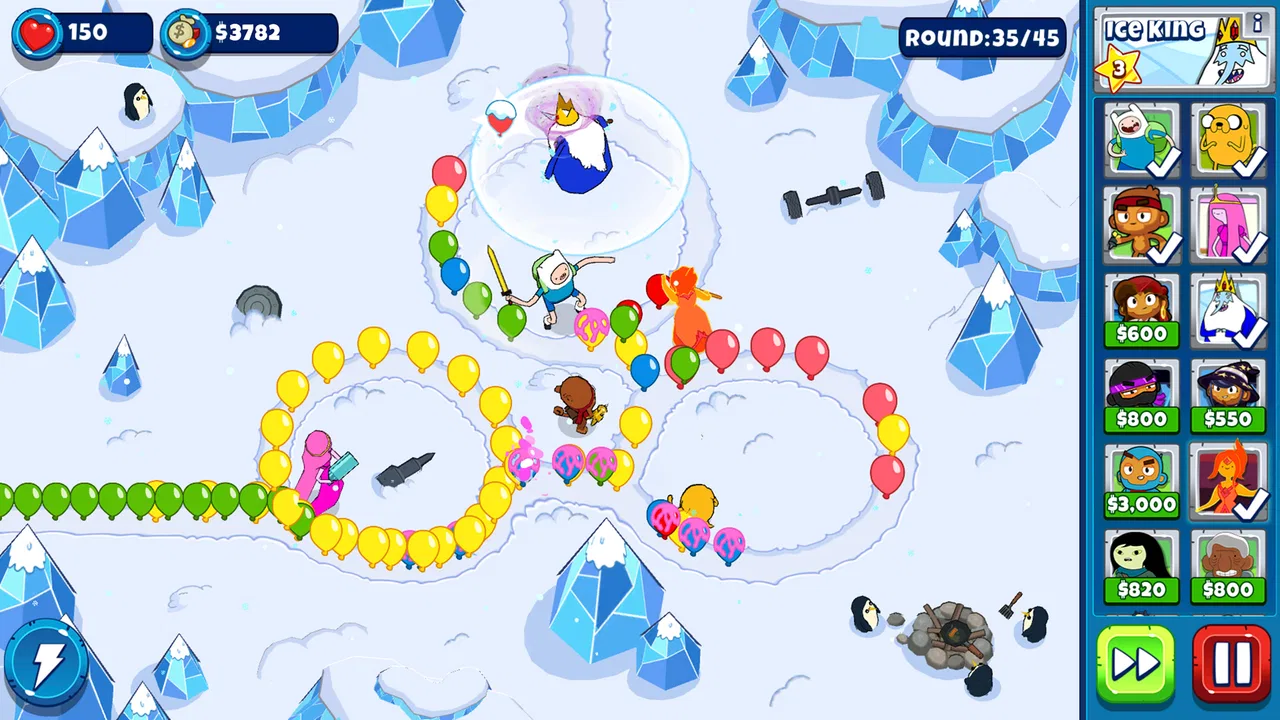
I spent time with Bloons Adventure Time TD expecting a familiar tower-defense game with a cartoon crossover layered on top. What stood out instead was how strongly the Adventure Time setting changes the way I approach each defense. The game is built around protecting Ooo from invading Bloons, but it does not feel like a simple reskin of a standard tower-defense board. Characters, placement choices, and the pressure of each wave make the crossover matter during play rather than only in the artwork.
This is a free strategy game from ninja kiwi, designed for Everyone and available on devices running Android 5.0 or later. Its scale is easy to understand from the community around it: it has passed the ten-million-install mark, carries a 4.5 average from roughly 99 thousand ratings, and has more than 8 thousand written reviews. Those figures suggest a well-established game, but they do not tell me whether it is a good fit for a particular player. My experience is that its strongest appeal is a focused, character-driven defense loop rather than endless complexity.
Why the character-driven defense is the real attraction
The most important capability here is the way familiar Adventure Time characters function as the heart of the defense. In many tower-defense games, units can feel interchangeable: one slows, one attacks quickly, another handles tough targets. Here, the crossover gives those decisions a clearer personality. I am not simply arranging anonymous turrets. I am building a team that feels connected to the world of Ooo, and that makes each placement easier to remember and more satisfying to adjust.
You May Also Like

 Blood Strike: 2.5 Anniversary
Blood Strike’s Loadouts Turn Every Drop Into a Tactical Gamble
A close look at Blood Strike’s custom loadouts: how fast access to signature weapons reshapes its battle royale rhythm, rewards preparation, and narrows the gap between fights.

 Pandora - Music & Podcasts
Pandora’s Music Is Easy to Start, but Harder to Recover
Pandora’s strength is its low-effort path from a seed to a station. Its weak spot is how much confidence it asks you to place in connection, setup, and quiet recovery.

 8 Ball Pool
 Is Built on Rivalries, Rematches, and Routine
A close look at the rivalries, rematches, shared routines, and unanswered safety questions that turn a quick pool match into a persistent mobile community.

 Samsung Music
’s Quiet Strength Is Playing What You Already Own
Its reach comes less from spectacle than from dependable access to a personal library. That simplicity is both the app’s strongest retention engine and its ceiling.

 AccuWeather: Weather Radar
AccuWeather Review: A Quick, Clear Forecast for Everyday Decisions
For everyday plans, the best forecast is the one you can understand quickly. AccuWeather makes rain timing, radar, and local conditions easy to act on, with a few trade-offs.

 Hill Climb Racing
Why Hill Climb Racing Still Turns Crashes Into One More Run
A tiny car, a bumpy hill and one more upgrade: Hill Climb Racing keeps resurfacing because its simple chaos makes every near-miss feel personal.
More From Our News Desk



That matters because tower defense depends on repeated small decisions. A unit placed near an entrance may get more opportunities to attack, while one positioned farther along the path can clean up Bloons that survived the first line. The characters make those decisions feel less abstract. I pay attention to who is covering a lane, which part of the route needs help, and whether my current arrangement is balanced enough to survive the next escalation.
The result is a game that sits between a traditional strategy title and a light adventure experience. It is approachable because the characters and setting soften the usual numbers-heavy presentation, yet it still asks me to think about timing, coverage, and the cost of improving a defense. The crossover is not just decoration; it gives every strategic adjustment a recognizable role in the story.
That focus also explains why the game works well for players who normally find tower defense intimidating. I can begin with the obvious goal of stopping the Bloons, then gradually notice deeper questions: am I relying too heavily on one attack type, have I left a weak point in the route, and am I spending resources on immediate damage when a more flexible setup would help later? The Adventure Time presentation makes those lessons feel natural rather than instructional.
How the defensive loop feels during a normal session
A typical session starts with a clear route and a manageable threat, but the comfortable opening can be misleading. Early waves give me time to understand where my units have the best reach. As the pressure increases, a setup that looked efficient can reveal a gap. Bloons may slip through because one section of the path is under-covered, or because I invested in a powerful position while ignoring the rest of the map.
I found that the best approach is to treat every placement as part of a chain. One character may handle the first contact, another may provide support farther down the path, and a final position can act as insurance. This is more reliable than putting everything near the beginning and hoping raw damage solves the problem. The game rewards me for looking at the whole route instead of reacting only to the Bloons currently on screen.
Upgrading is where the strategy becomes more personal. When I have limited resources, I have to choose between making a strong character better or spreading improvements across several positions. The first option can make the opening waves feel easy, but it may leave the defense fragile when the route becomes busier. The second option offers broader coverage, although it can delay the moment when any one unit becomes truly effective.
One useful habit is to watch what escapes rather than only what gets defeated. If Bloons are consistently reaching the final stretch, I do not automatically upgrade the nearest character. Sometimes the more valuable correction is a unit with a different position or function, because the real problem is not insufficient damage but poor timing and coverage. This small change in thinking helped me avoid wasting resources on upgrades that looked impressive but did not fix the actual weakness.
The game is also well suited to short, repeatable sessions. I can play when I have enough time for a complete defense, but I do not need to treat every attempt as a long commitment. That makes it practical for a commute, a break, or an evening when I want strategy without learning a huge ruleset. The colorful presentation keeps the mood relaxed, while the later decisions still give the session enough tension to feel worthwhile.
What I would do in the best everyday scenario
My favorite use case is a short evening session when I want something more engaging than a casual tap game but less demanding than a large strategy campaign. I can start a map, build an initial defense, and use the first waves to test whether my plan is sound. If the arrangement fails, the failure is usually understandable: a lane was neglected, an upgrade came too late, or I committed too much to one position.
That clarity makes retrying enjoyable. I am not starting over blindly; I am changing one or two decisions and seeing whether the defense holds longer. For a player who enjoys solving compact tactical problems, this is the right rhythm. The game gives enough room for experimentation without requiring a spreadsheet or a long uninterrupted session.
It is particularly appealing for someone who already likes Adventure Time and wants a game that uses the characters in an active way. A fan will recognize the tone and presentation, but even a newcomer can understand the basic objective quickly. The age rating of Everyone also makes the presentation broadly approachable, especially for families looking for a strategy game without a grim atmosphere.
There is another practical scenario where it works well: introducing a younger or less experienced player to tower defense while still having meaningful choices available. I can explain the basic idea in seconds—place defenders, watch the route, and improve weak spots—then let the player discover why a seemingly strong setup can fail. The cartoon style lowers the barrier to entry, while the defense decisions provide more substance than a purely automatic game.
I would not choose it, however, if my priority were a highly competitive strategy experience with constant multiplayer pressure or a huge collection of systems to master. Its appeal comes from the focused blend of Bloons defense and Adventure Time character identity. Players who want a serious simulation, a realistic military theme, or a sprawling management game may find the presentation too light and the scope too contained.
The tradeoffs behind the free download
The game costs nothing to download, which makes it easy to try without a financial commitment. That is useful because the crossover may be the deciding factor: if the characters and world do not appeal to me, the underlying tower-defense structure may not be enough to keep me playing for a long time. Trying it first is more sensible than assuming the license alone guarantees a good fit.
There are in-app purchases, ranging from $0.99 to $99.99 per item. I consider that an important part of the decision, even though the game can be approached as a free download. Players who dislike seeing optional purchases in a game should be aware of that structure before settling in. I also recommend deciding in advance whether I am willing to spend anything, because a clear personal limit keeps the focus on improving my strategy rather than chasing convenience.
The free-to-start model can also affect how different people experience progression. A patient player may enjoy experimenting with the available tools and learning the maps, while someone who wants immediate access to every possibility may feel more pressure to spend. That is not a small distinction. The game is most enjoyable for me when I treat purchases as optional and let successful defenses come from better planning.
Another tradeoff is the balance between accessibility and depth. The presentation is friendly, and the objective is easy to grasp, but that does not mean every decision is trivial. At the same time, it does not aim to become an exhaustive strategy laboratory. Compared with a more traditional tower-defense alternative, this game puts more emphasis on recognizable characters and crossover flavor. Compared with a very casual mobile game, it asks me to pay closer attention to placement and resource use.
That middle ground is its strength for many players, but it can also be its limitation. Dedicated tower-defense fans may want more layers, more experimentation, or a longer-term challenge than this compact format provides. Casual players may enjoy the first few sessions but lose interest if they do not like retrying maps and refining a plan. I would recommend it most confidently to people who enjoy tactical repetition with a strong theme.
Small habits that make the game easier to read
My first practical tip is to avoid upgrading automatically after every successful wave. A victory can hide a structural problem, especially when the next wave changes the pressure on the route. I prefer to pause and ask whether the upgrade improved the weakest part of the defense or simply made an already-safe position stronger. That habit preserves resources for the moments when a real correction is needed.
Second, I try to leave a little room for adjustment. A defense that uses every available resource immediately may look efficient, but it gives me fewer options when a difficult wave exposes a weakness. Holding back enough to respond is often more valuable than maximizing early power. This is especially useful when I am still learning how a map’s route affects the reach and timing of my characters.
Third, I judge a character by the job it performs in my current arrangement, not by how appealing it is on its own. A favorite character may be fun to use, but forcing that unit into every plan can create predictable gaps. I get better results when I let the route decide the role and then build a team around coverage. That approach keeps the Adventure Time theme enjoyable without allowing personal preference to replace strategy.
Finally, when a defense fails, I change one variable at a time. Moving several characters, buying multiple upgrades, and restarting immediately can make it impossible to understand what worked. A more controlled retry—different placement, earlier support, or a delayed upgrade—turns failure into useful information. This is one of the game’s quiet strengths: its short tactical loop makes testing ideas practical.
Who will gain the most from this particular mix
The best audience is someone who wants a friendly-looking strategy game with enough resistance to reward attention. Adventure Time fans have an obvious reason to try it, but the game also suits players who enjoy tower defense in short bursts and appreciate a cast with personality. It is a good choice for a first step into the genre because the goal is clear, the visual language is inviting, and the consequences of a poor setup are easy to observe.
It also works for experienced players who want a lighter companion to more demanding strategy games. I would not expect it to replace a deep, system-heavy tower-defense favorite, but it can fill a different role. When I want a colorful tactical puzzle rather than a long campaign of optimization, its focused design is more convenient. The ability to retry and refine a defense gives it enough substance for repeat play without making every session feel like homework.
Players who should skip it are those who strongly dislike crossover themes, want a realistic visual style, or expect every strategic option to be available immediately. I would also be cautious about recommending it to anyone who finds optional purchases distracting. The free entry point is attractive, but the presence of purchases means the experience is better suited to people comfortable setting their own boundaries.
The current version is 1.7.7, and the game has been available since August 28, 2018. That history helps explain why it feels like an established mobile title rather than a brand-new experiment. I see it as a polished meeting point between two recognizable ideas: the route-management tension of Bloons and the playful world of Adventure Time. The important question is not whether it reinvents tower defense, but whether that combination makes the familiar loop more enjoyable for me.
After playing it, my answer is yes, with a clear qualification. Its strongest feature is the way a recognizable cast turns ordinary defensive choices into memorable tactical decisions. I would recommend it to a friend who wants a free, approachable strategy game and enjoys learning through retries. I would not recommend it to someone seeking deep competitive systems or a completely purchase-free experience. For the right player, though, it offers a genuinely pleasant way to spend a short session: build a defense, notice where it breaks, rethink the plan, and try again with a better understanding of Ooo’s routes.
FAQs for Bloons Adventure Time TD
01What is Bloons Adventure Time TD about?
Bloons Adventure Time TD is a tower defense game that combines the playful world of the animated series Adventure Time with the strategic elements of the Bloons series. Players join Finn, Jake, and other characters to pop bloons and defend the Land of Ooo from various threats. It's a blend of fun and strategy with a unique storyline.
02Is Bloons Adventure Time TD free to play?
Yes, Bloons Adventure Time TD is free to download and play. However, it does offer in-app purchases that can enhance your gaming experience. These purchases may include character upgrades, special items, and other features to help you progress through the game more smoothly.
03What platforms is Bloons Adventure Time TD available on?
Bloons Adventure Time TD is available on both Android and iOS platforms. You can download it from the Google Play Store or the Apple App Store. It’s designed to run smoothly on most modern smartphones and tablets, providing an immersive gaming experience.
04Are there any multiplayer features in Bloons Adventure Time TD?
Bloons Adventure Time TD primarily focuses on a single-player experience, where you progress through various levels and challenges. While it doesn't offer traditional multiplayer modes, you can connect with friends through social features, compare scores, and share achievements.
05What age group is Bloons Adventure Time TD suitable for?
Bloons Adventure Time TD is suitable for players aged 10 and older. The game features colorful graphics and characters from Adventure Time, making it appealing to both younger and older audiences. However, the strategic gameplay and occasional in-app purchases may require some parental guidance for younger players.
Pros
- Engaging crossover with Adventure Time.
- Offers diverse character upgrades.
- Visually appealing graphics.
- Regular updates with new content.
- Strategic gameplay with varied challenges.
Cons
- Can feel repetitive over time.
- In-app purchases can be pricey.
- Requires constant internet connection.
- Occasional lag on older devices.
- Limited offline play options.

Bloons Adventure Time TD
Gallery